How to Pack a Carry-On for 10 Days (and Skip the Checked-Bag Fee)
Ten days, one carry-on, zero checked-bag fees, zero waiting at the carousel, zero lost luggage. It sounds like a travel-influencer fantasy, but it's just a system: cube your clothes, compress the bulky stuff, weigh the bag before you leave, and pick luggage designed for the job. Here's the complete method, step by step.
Why carry-on only is worth learning
The math is simple. Checked bags cost $35 to $75+ each way on most airlines now, so a round trip can add $70 to $150 to every vacation. Then there's the time: 20 to 40 minutes at the carousel, each way. And the risk: mishandled baggage rates spike during peak travel seasons. Carry-on only eliminates all three — and once you learn the system, packing takes less time, not more, because every item has a designated home.
The secret nobody tells you: it's not about packing less. It's about packing smarter — which is a gear problem with a gear solution.
Step 1: Cube everything
Packing cubes are the foundation of the entire system. Instead of one chaotic suitcase compartment, you get labeled zones: tops in one cube, bottoms in another, undergarments in a small one. Getting dressed becomes "grab the tops cube" instead of an excavation. Repacking at a hotel takes two minutes. And TSA repacks your bag neatly instead of leaving a crime scene, because cubes are self-contained.
An 8-set sounds like a lot until you use it — the variety of sizes is the point. Use the large cubes for bulky items, mediums for everyday clothes, and the small ones for accessories, chargers, and the miscellaneous items that otherwise vanish into suitcase corners.
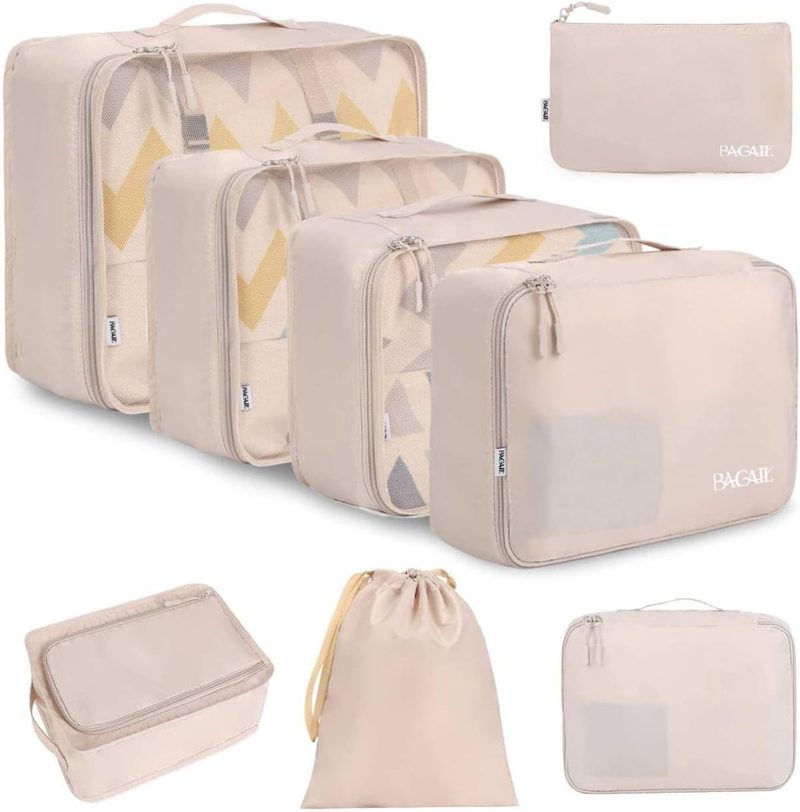
BAGAIL 8-Set Packing Cubes
Eight packing cubes that turn suitcase chaos into neat, grab-and-go compartments for every category of clothing.
Check price on AmazonAs an Amazon Associate I earn from qualifying purchases.
How to use them: roll casual clothes (t-shirts, knits) to prevent wrinkles and save space; fold structured items (button-downs, blazers). Fill each cube completely — half-empty cubes shift and waste space.
Step 2: Compress the bulky stuff
Cubes organize; compression cubes shrink. They add a second zipper that squeezes the air out after packing, cutting bulky items — sweaters, hoodies, jeans, puffer jackets — down to roughly half their volume. For cold-weather trips or anyone who runs cold and packs "just in case" layers, this is the difference between carry-on and checked bag.
Use compression cubes selectively: they're slightly heavier than standard cubes, so deploy them on the bulky categories and use regular cubes for everything else.
BAGAIL Compression Packing Cubes
Expandable cubes with a second compression zipper that squeezes bulky clothes flat so more fits in a carry-on.
Check price on AmazonAs an Amazon Associate I earn from qualifying purchases.
Pro tip: compression works best on soft, air-trapping fabrics. Don't bother compressing structured items — you'll just wrinkle them for no gain.
Step 3: Weigh the bag before you leave
Here's where trips get ruined: the airport scale reads 54 pounds, the limit is 50, and you're performing the frantic gate-side shuffle of stuffing a sweater into your personal item while a line forms behind you. A digital luggage scale eliminates this entire genre of travel stress. Hook it on, lift for three seconds, read the number. Do it the night before, and do it again before the return flight (souvenirs count).
Etekcity Digital Luggage Scale
A pocket-size digital scale that weighs your bag at home in seconds, so you never pay an overweight fee at the airport counter.
Check price on AmazonAs an Amazon Associate I earn from qualifying purchases.
Know your limits: most US airlines cap checked bags at 50 lbs, but carry-on weight limits vary wildly by airline and region — some international carriers enforce 15-22 lb carry-on limits. Check your specific airline before you pack.
Step 4: Plan for sleep, not just packing
A packing system gets your stuff there; a travel pillow gets you there functional. The classic U-pillow lets your head fall forward — which is why you wake up with a stiff neck. Wrap-style pillows support your head upright against the seat, which is the only position that produces real sleep in economy.
This is also the highest-impact comfort purchase per dollar in travel: better sleep on the flight means you land usable instead of losing your first day to exhaustion.
trtl Pillow Plus
A wrap-style travel pillow designed to support your head upright, so you can actually sleep instead of doing the head-bob.
Check price on AmazonAs an Amazon Associate I earn from qualifying purchases.
Side sleepers: if you sleep on your side at home, a plusher 360-degree memory-foam pillow may suit you better than a wrap style — packability versus comfort is the real tradeoff.
Step 5: Pick a bag designed for the job
All the cubes in the world can't fix a bag that's the wrong size or shape. For carry-on-only travel, you want a weekender-style duffel or small carry-on with a separate shoe compartment (shoes are the enemy of clean packing), a sleeve that slides over your rolling suitcase handle, and dimensions that fit under the seat as a personal item when you want to travel truly light.
LOVEVOOK Travel Weekender Duffel
A weekender duffel with a separate shoe compartment and a back sleeve that slides over your suitcase handle, sized to fit under the seat.
Check price on AmazonAs an Amazon Associate I earn from qualifying purchases.
The two-bag strategy: pair a rolling carry-on with a weekender as your personal item. Cubes go in the roller; pillow, tech, documents, and a change of clothes go in the weekender. If the roller gets gate-checked, you're still fine.
The 5-4-3-2-1 packing formula
For a 10-day trip, start here and adjust for climate:
- 5 tops — mix of casual and one nicer option; merino or synthetics you can re-wear
- 4 bottoms — including what you wear on the plane
- 3 pairs of shoes max — wear the bulkiest; this is where most people overpack
- 2 layers — a light jacket and a warmer mid-layer, compressed flat
- 1 set of "nice" clothes for the fanciest thing you'll do
Then add: undergarments for the trip length (they're small), toiletries in a hanging organizer, tech in one pouch, documents in one wallet. Everything else is negotiable.
Common carry-on mistakes
- Packing for "what if" instead of "what's planned." Every "just in case" item gets carried for 10 days and worn zero times. Be ruthless.
- Ignoring the return trip. Souvenirs and dirty laundry (which packs larger than clean) need space. Leave one cube empty on the way out.
- Forgetting liquids rules. 3.4oz/100ml containers, one quart bag, in an accessible pocket — not buried under cubes.
- No change of clothes in the personal item. If your carry-on gets gate-checked, you want essentials within reach.
Frequently asked questions
Can you really fit 10 days in a carry-on?
Yes — with cubes and compression, a 21-inch carry-on holds 10 days of warm-weather clothes comfortably. Cold-weather trips are tighter; that's exactly when compression cubes earn their place.
Do packing cubes actually save space, or just organize?
Standard cubes mostly organize (which indirectly saves space by eliminating dead air). Compression cubes genuinely save space — expect roughly 30-50% volume reduction on bulky items.
What if my airline has strict carry-on weight limits?
Weigh your packed bag at home with a luggage scale, wear your heaviest items (boots, jacket) on the plane, and shift dense items like books and chargers to your personal item, which is rarely weighed.
Roll or fold clothes for packing cubes?
Roll knits and casual clothes (fewer wrinkles, better space use); fold structured items like button-downs and blazers. Fill cubes completely either way.
Ready to gear up? Browse the full travel accessories collection — or find the perfect present in our gifts for travelers guide.